
Market Winners Stall as Oil Prices Revive Inflation Fears
Commodities and stocks continue to drive solid gains in global asset allocation strategies in 2026, based on a set of ETFs tracking the major asset classes through Friday’s close. Upside momentum among the leading performers has stalled in recent weeks, however, as inflation concerns and geopolitical risks weigh on investor expectations. Even so, the data currently in hand leave little doubt that risk assets remain the primary source of strength, providing a favorable backdrop for diversified portfolios.
As markets head into the final stretch of the year, commodities are still the upside outlier, outperforming the rest of the field by a wide margin. The implication: global strategies that have been light on the asset class have faced headwinds in relative terms against competitors.
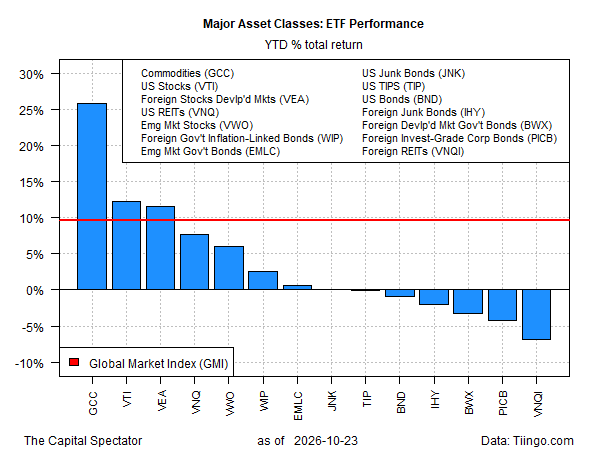
The WisdomTree GCC Commodity ETF (GCC) is up nearly 26% so far in 2026, far ahead of the rest of the pack. Stocks in the US (VTI) and foreign developed markets (VEA) are distant second- and third-place performers this year via roughly 12% gains each year to date.
The top-three performers this year continue to outperform the Global Market Index (GMI), an unmanaged benchmark (maintained by CapitalSpectator.com) that holds all the major asset classes (except cash) in market-value weights via ETFs and represents a competitive benchmark for multi-asset-class portfolios. GMI’s 9.6% return for 2026 is a solid win for index, although it’s running at about half its full-year gain posted in 2025.
Investors are wondering if the recent peaks for markets will mark the high point for 2026. Optimists argue that markets are consolidating recent gains and laying the groundwork before pushing higher. But with several threats to sentiment lurking, it’s clear that investors have turned cautious, a bias that’s likely to persist until trend signals improve.
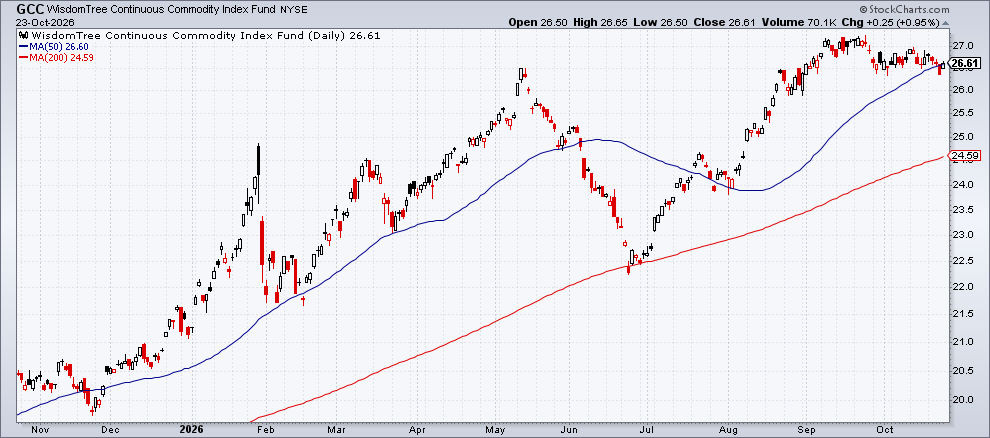
What’s beyond debate is that this year’s winners continue to trade in a range, at best. Commodities (GCC) have been flatlining for much of the past month.
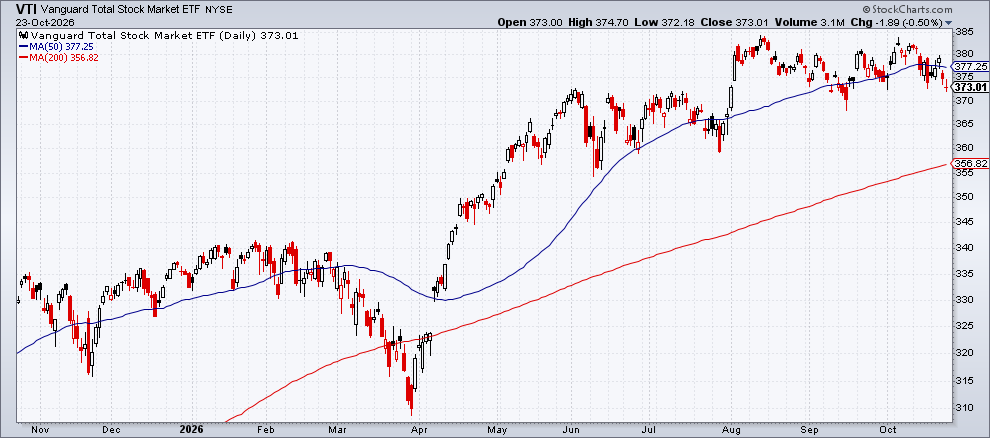
US stocks (VTI) have been moving sideways for longer, holding within a narrow band since August.
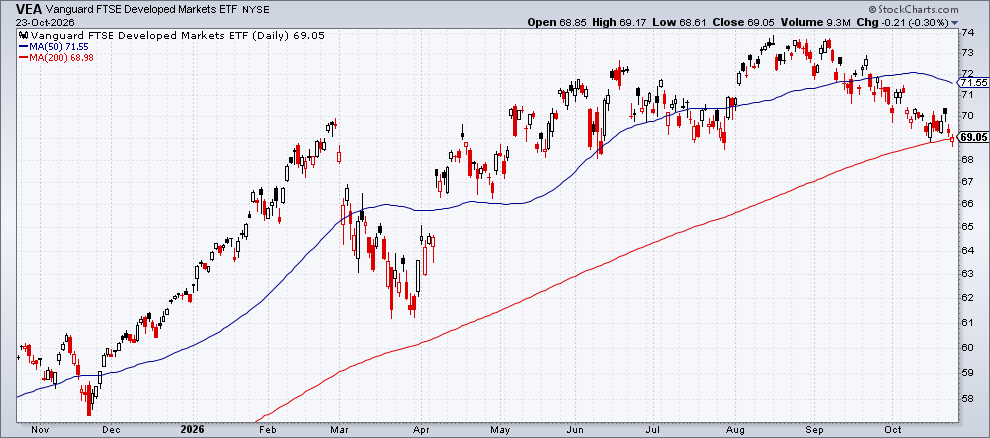
By contrast, equities in foreign-developed markets (VEA) are posting a clear downside bias, which may be an early sign that the correction will persist. Notably, VEA closed on Friday at its 200-day average, the ETF’s weakest technical posture since April 2025. A further drop below this level would deepen concern for the fund’s outlook.
The case for caution on stocks generally looks reasonable at the moment as investors wrestle with the implications for several risk factors. The inflation question is on the short list, raising questions about whether the recent rise in interest rates marks a peak or a pause in an ongoing upcycle for pricing pressure.
At the same time, investors are increasingly debating whether the massive wave of spending tied to artificial intelligence will ultimately generate earnings growth sufficient to justify current valuations. As AI-related capital expenditures continue to surge, skepticism is growing over the timing and scale of future returns, raising concerns that expectations for the sector may have become overly optimistic.
Meanwhile, the Federal Reserve is expected to keep investors guessing this week by keeping rates steady. The market is pricing in a 90% probability that the central bank will leave its target rate steady at Wednesday’s policy meeting, but a hike is considered likely in December, based on Fed funds futures.
A day after this week’s Fed announcement investors will focus on Thursday’s September data for the Personal Consumption Price Index, which is expected to show that inflation accelerated last month (in line with the previously released Consumer Price Index numbers for September).
Fears of a renewed Iran conflict have resurfaced amid reports that the U.S. and Israel are considering additional military strikes against Iranian nuclear, energy, and missile facilities, highlight concern that a fragile ceasefire could unravel and trigger a broader regional escalation. Investors are particularly focused on the risk of disruptions to Middle East oil supplies and shipping routes, which could reignite inflation pressures and increase market volatility.
In a sign of the renewed tension coursing through markets, the US oil benchmark – West Texas Intermediate (WTI) – has rallied recently and looks set to test the peak reached in the early days of the war.
WTI close above $100 barrel on Friday. Oil is a useful benchmark for gauging investor concern about additional Iran-related fallout. If it continues to approach its previous peak in the spring – roughly the $115-$120 range – that would suggest investors are increasingly pricing in the risk of a broader regional conflict and/or the potential for meaningful disruptions to global energy supplies.
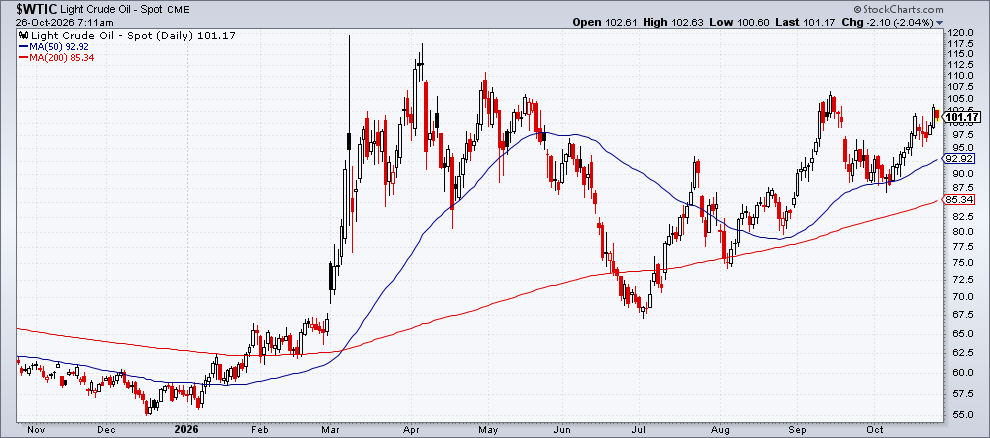
For now, minds differ on the likely path ahead. But no matter the logic of the analysis, the price of oil will be increasingly difficult to dismiss if it climbs further. Oil prices increasingly reflect geopolitical risk rather than underlying supply-and-demand conditions as fears of renewed conflict with Iran intensify. The question is when Middle East events will present a compelling reason to revise the outlook in favor of the bulls.