
August 1, 2026 Market Update
Market Recap: Markets Hit Turbulence
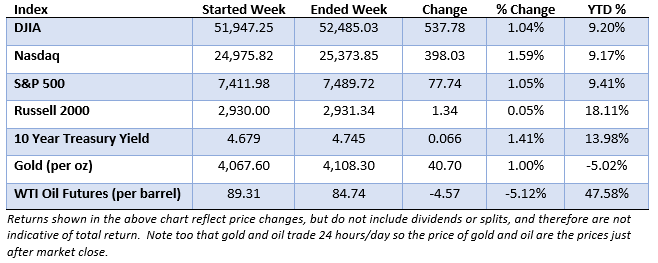
Wall Street experienced another volatile week as concerns about Federal Reserve policy, geopolitical tensions, and renewed inflation pressures put investors on edge. Stocks fell sharply Wednesday after the Fed left interest rates unchanged and offered little guidance on its next move. However, equities bounced back over the final two trading days, led by Microsoft’s 15.5% jump Thursday and Amazon’s 15.3% surge Friday following strong quarterly results for both companies. Their gains helped ease doubts about whether heavy artificial intelligence spending can justify today’s stock valuations.
Treasury yields climbed during the week amid growing concerns that persistent inflation could eventually force the Fed to raise interest rates. Renewed military strikes between the United States and Iran caused oil prices to jump sharply, reviving fears that higher energy costs could keep inflation elevated.
This week’s volatility places even greater importance on upcoming corporate earnings reports. Weaker-than-expected results or further evidence that artificial intelligence spending is growing faster than the profits it generates could add to investors’ jitters.
Market Performance
Market Commentary: Actions Speak Louder Than Words.
In his comments following this week’s meeting of the Fed’s policy-setting Open Market Committee, Chairman Warsh reiterated that the Federal Reserve has no tolerance for persistently elevated inflation and remains firmly committed to returning inflation to 2%. However, the bond market appears to be waiting for actions rather than assurances.
The decision to keep interest rates steady suggests to some that America’s central bank is unwilling to raise rates to control inflation, despite three policymakers voting to do so. Meanwhile, the bond market delivered its own verdict, with the 30-year Treasury yield hitting its highest yield since 2007 after Warsh’s remarks. Higher yields can help restrain inflation without a Fed rate increase, but they also raise borrowing costs for households, businesses, and the federal government.
Warsh is still early in his tenure, and investors have not yet seen how aggressively he will respond when inflation and economic growth point in conflicting directions. Until inflation declines or the Fed demonstrates a willingness to tighten further, Mr. Market can be expected to question whether Warsh’s 2% commitment will be backed by sufficiently restrictive policy.
In Case You Missed It. Cash is King.
Assets held in U.S. money market funds totaled $7.86 trillion during the week ended July 22, remaining near historic highs. The liquidity, stability, and attractive yields offered by money market funds have made cash increasingly competitive with other investment alternatives.