
August 15, 2026 Market Update
Market Recap: Rate Pressures Ease as Signs of a Cooling Economy Grow.
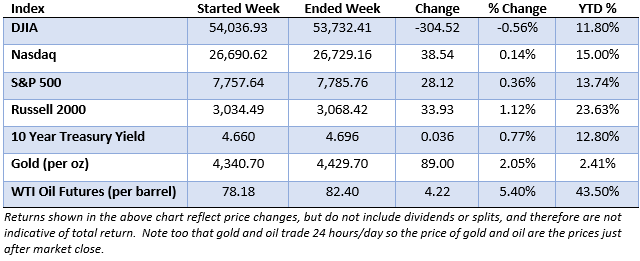
U.S. stocks moved modestly higher this week, with the S&P 500 recording another all-time high after a choppy start to the week. Investor sentiment was bolstered after July consumer inflation eased to 3.4% and wholesale prices remained unchanged. However, Friday’s weaker-than-expected retail sales report, combined with last week’s soft jobs report, suggests the economy may be starting to cool.
Meanwhile bond investors continued to view recent inflation data with skepticism. Yields were largely unchanged as investors continued to balance signs of cooling inflation against concerns about government borrowing and longer-term price pressures.
This week’s inflation and spending reports have reduced concerns that the Federal Reserve will need to raise interest rates in September. But the larger question remains: Does the economy have to weaken for inflation to cool significantly?
Market Commentary: Wall Street Is Watching The Yen.
The Japanese yen has become an unlikely source of concern for global markets. After falling to its weakest level in almost 40 years, Japan and the United States began jointly buying yen to support the currency. The U.S. also took the highly unusual step of selling euros to purchase yen. Both governments have indicated that additional action remains possible.
The U.S. has good reason to pitch in:
- Japan remains the largest foreign holder of U.S. Treasury securities, and repeated Japanese sales of Treasuries to finance currency intervention could put additional upward pressure on U.S. interest rates.
- A sharply stronger yen makes so-called carry trades—where institutional investors borrow cheaply in Japan and invest the proceeds in higher-returning assets elsewhere—less profitable, potentially leading to forced sales of U.S. stocks and bonds.
- A strong Japan also serves as an important counterweight to China’s growing influence in the Pacific region.
Whether this joint intervention will stabilize the yen remains to be seen. A gradual recovery in the yen would likely attract little attention on Wall Street. Further decline, but a sudden reversal triggered by overly aggressive intervention could have adverse ripple effects. Either way, the yen’s current struggles serve as another example of how quickly problems in one corner of the global financial system can spill into another.
In Case You Missed It: America's Borrowing Costs Are Rising.
The U.S. Treasury sold $25 billion of 30-year bonds Thursday at a yield of 5.216%, the highest borrowing cost for a 30-year Treasury auction in 25 years. While still far from an all-time high, elevated Treasury yields increase the government’s interest expense, limit fiscal policy options, and create another potential headwind for the current bull market.