
August 22, 2026 Market Update
Market Recap: Rising Rates, Lower Markets
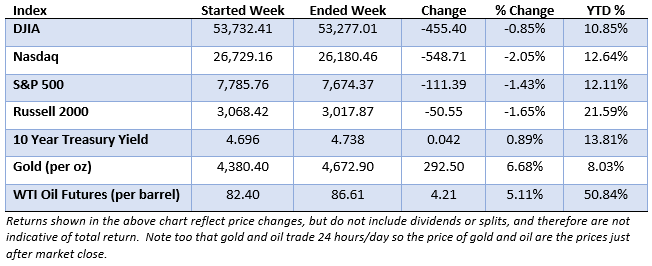
The stock market experienced a turbulent week. Climbing oil prices (with Brent Crude near $94 a barrel), escalating economic tensions involving Iran, disappointing retail earnings from Walmart and others due to consumer pullbacks amid rising gas prices all contributed to investors’ risk-off sentiment. Global stocks also struggled amid ongoing economic strain.
Massive national debt concerns and an influx of artificial intelligence-related corporate debt continue to push interest rates higher and bond prices lower. A midweek announcement by Treasury Secretary Scott Bessent that his department would double the size of its long-term Treasury bond buybacks only provided temporary relief before yields bounced back up.
Next week, the market's attention will turn to the Federal Reserve’s annual economic symposium in Jackson Hole, Wyoming. Mr. Market will be listening closely for hints about the central bank's future policy path, hoping to determine whether even tighter financial conditions are in store heading into the fall.
Market Performance
Market Commentary: The Upside of Falling Bond Prices
As noted last week, the yield on the 30-year U.S. Treasury rates have climbed to heights not seen in decades, while the 10-year Treasury has been hovering around 4.7%. Because bond prices move in the opposite direction of yields, those rising rates have pushed the market value of existing bonds lower.
Bond investors, however, have less reason than stockholders to focus on short-term price movements.
- Investors who hold individual bonds to maturity will generally continue receiving the promised interest payments and ultimately receive the bond’s face value, so long as the issuer does not default.
- Bond funds receive principal as their holdings mature and can reinvest those proceeds in new bonds offering today’s higher yields.
- Inflation presents a different risk because it can erode the purchasing power of future interest and principal payments.
Treasury Inflation-Protected Securities, or TIPS, can help mitigate inflation risk because their principal adjusts with inflation. Ten-year TIPS currently offer a real yield of about 2.4%, meaning investors can earn roughly 2.4% annually above the rate of inflation if held to maturity. Thirty-year TIPS offer a real yield of roughly 3%.
Bonds’ traditional role as ballast against stock market volatility can come under pressure when rates rise. But long-term investors in high-quality bonds and bond funds have less reason to fret about short-term price declines. Higher yields can mean lower prices today, but they also mean more income tomorrow.
In Case You Missed It: $40,000,000,000,000 and Counting
The U.S. national debt surpassed $40 trillion this week. If every dollar represented a mile, that would be equivalent to traveling from Earth to the sun and back more than 214,000 times, a distance it would take a spaceship traveling at the speed of light seven years to cover.