
December 6, 2025 Market Update
Market Recap
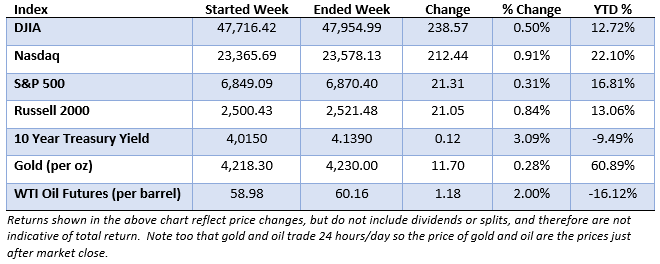
Stocks pushed higher this week after reports showed slower hiring, more moderate consumer spending, and stabilizing inflation. Traders welcomed the softer readings, expecting the data to encourage the Federal Reserve to cut rates further in December. Lower rates reduce borrowing costs, which can lift profits and, in turn, support stock prices.
In the bond market, yields moved lower as expectations for a near-term rate cut increased. Trading was somewhat subdued and cautious ahead of Friday’s release of the Personal Consumption Expenditures Index. The September report showed softening consumer spending, and Core PCE dipped by 0.1%.
Mr. Market appears to be betting once again on a soft landing for the U.S. economy, a mix of slower inflation and gentler growth. Whether that bet pays off is an open question, but for now investors seem willing to go along for the ride.
Market Performance
Market Commentary: Japan’s Bond Market Steps Into the Spotlight
Japan’s bond market moved to center stage this week following a sharp move higher in Japanese government bond yields. The yield on Japan’s 10-year government-bond yield closed the week at 1.945%, the highest since 2007, after Bank of Japan Gov. Kazuo Ueda said the Bank isn't sure how many more interest-rate hikes might be required.
- The sharp rise in Japanese government bond yields was driven by concerns that stubbornly high inflation and persistent wage growth may force the country to shift from its decades-old policy of keeping them near zero.
- The bond selloff has also been driven by Japan’s plan to boost short-term debt issuance to help fund its largest stimulus package since the COVID-19 pandemic.
- The recent jump in Japanese yields threatens the popular “carry trade,” in which investors borrowed cheaply in yen and invested in higher-yielding assets abroad.
As Japanese yields rose, U.S. Treasury yields moved up too. That’s partly because some investors, including Japanese institutions, have incentives to pull money out of foreign bonds (like U.S. Treasuries) and shift it into Japanese bonds now offering better returns.
Japan’s policy evolution is a useful reminder that decisions by international central banks can influence U.S. markets, and even slow-moving central banks can surprise when the ground starts to shift beneath them.
In Case You Missed It: Talk About Self Confidence.
Apple has bought back $709 billion in stock over the past 10 years, which is greater than the market cap of 487 companies in the S&P 500.