
February 14, 2026 Market Update
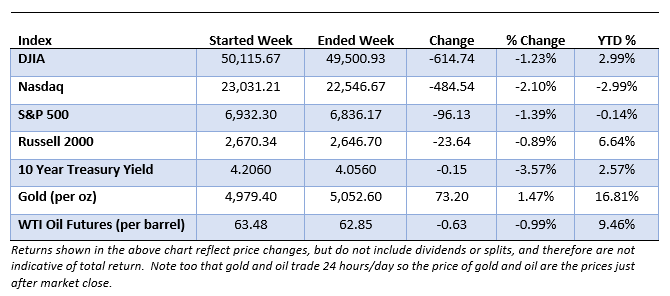
Market Recap: AI Scare Spreads On Wall Street
The rotation out of high-fee, labor-intensive business models viewed as potentially vulnerable to AI-driven disruption continued this week. Commercial real estate, tax planning, and wealth management firms were among those caught up in the so-called “AI Scare Trade.” Meanwhile, old-economy value stocks have come back into favor as investors pivot toward companies with tangible earnings, durable cash flows, and less exposure to automation-driven disruption.
Treasury rates declined alongside the stock selloff, with longer maturities outperforming as investors sought relative safety amid the equity market’s volatility. Despite the drop in yields, the U.S. dollar remained stable, supported by constructive economic data and further evidence of cooling inflation. Some viewed the reports as a sign that the economy may be shifting from a late-cycle expansion toward a more sustainable growth footing.
Equity investors seem less convinced. As discussed in our TMC Research post last week, many have gotten more defensive as signs of stock market stress grow. Will this rotation be temporary or a more durable shift in leadership? Stay tuned.
Market Performance
Market Commentary: Hanging Tough
In an unusual turn of events, two of the most influential economic updates were released in a single week.
- The January 2026 U.S. labor report, released on Wednesday, showed 130,000 nonfarm payroll jobs were added last month. It was the greatest increase in the workforce in over a year, with nearly all of the new jobs related to healthcare. The unemployment rate declined to 4.3% from 4.4% in December.
- Friday’s Consumer Price Index report suggests that concerns about tariff-driven price pressures may have been premature (at least for now). Annual CPI fell to 2.4% (down from 2.7% in December), marking the lowest level since May 2025. Core CPI, which excludes food/energy, rose 2.5% year-over-year, its slowest pace since early 2021. On a monthly basis, core prices rose 0.3%.
- Taken together, it seems unlikely that the Fed will be cutting rates before Jerome Powell’s tenure as Chairman of the Federal Reserve ends on May 15, 2026.
Powell hasn’t said whether he will stay on the Federal Reserve Board after his term as Chair ends. Regardless, his legacy will likely be marked by how he guided the country’s economy during the Covid crisis, and how he stuck to his guns in the face of immense political pressure while preserving the Fed’s independence.
In Case You Missed It: Washington Spending Like There is No Tomorrow
The Congressional Budget Office reported last week that the U.S. is projected to run a $1.85 trillion deficit this fiscal year, or 5.8% of gross domestic product. By 2036, the annual deficit will exceed $3 trillion, or 6.7% of GDP, according to CBO.