
January 31, 2026 Market Update
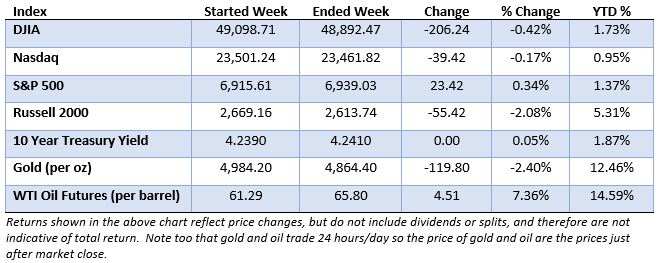
U.S. equity markets finished the week mixed, as investors balanced a number of earnings reports against economic data that suggested growth is slowing from last year’s pace but not dramatically so. While companies like Meta and Apple delivered solid results, Microsoft’s cautious outlook sparked concerns about the timetable for a payoff on AI investments that weighed heavily on the software sector.
Interest rate expectations remained a primary driver of bond market sentiment following the Federal Reserve’s decision to keep rates steady. Yields moved modestly higher as the Fed acknowledged a “stronger than expected” economy, putting upward pressure on market rates while supporting the U.S. dollar. With the 10-year Treasury yield hovering near 4.25%, Mr. Market has adopted a cautious approach toward further rate cuts in the first half of the year.
Looking ahead, next week the market’s focus shifts to the January Jobs Report and another wave of earnings from companies like Disney and Palantir. As February begins, volatility remains contained and the prevailing theme is one of moderation as investors appear increasingly aware that patience and disciplined diversification will be needed to navigate the year.
Market Performance
Market Commentary: A New Chapter at the Federal Reserve
President Trump has announced his intention to nominate Kevin Warsh, 55, as the next Chair of the Federal Reserve. If confirmed by the Senate, Mr. Warsh will take the reins from Jerome Powell this May. His confirmation would likely mark a meaningful shift from the policy approach associated with Powell’s leadership.
Warsh served on the Fed’s Board of Governors from 2006 to 2011, a period that included the global financial crisis. During that time, he earned a reputation as a pragmatic problem-solver and served as a key link between policymakers and the private sector.
Warsh’s nomination reflects the White House’s push for a more market-friendly direction at the central bank. Key takeaways for investors include:
- Potential for Lower Rates: Warsh has previously expressed openness to lower rates to support affordability and economic activity.
- A “Back to Basics” Fed: He has advocated refocusing the Fed on its core mission of price stability and sustainable growth.
- Market Credibility: His experience during past periods of market stress may help support confidence during the leadership transition, though his exact policy stance remains to be clarified amid competing pressures for lower rates and inflation control.
- Technology and Productivity: Warsh has argued that technological gains could allow for stronger growth without reigniting inflation pressures.
The nomination now moves to a potentially contentious Senate confirmation process amid broader debates over Federal Reserve independence. Whatever the outcome, new leadership at the Fed is likely to remain an important factor shaping market expectations, interest rate outlooks, and risk sentiment in the months ahead.
In Case You Missed It: China’s Cautious Consumers Causing Concerns (Say that ten times fast!)
Chinese households accounted for just 40% of China’s GDP in 2024, well below the roughly 68% in the U.S. and about 55% globally, according to the World Bank. With domestic consumption lagging, China’s economy remains heavily reliant on exports, which produced a record $1.19 trillion trade surplus in 2025.