
July 25, 2026 Market Update
Market Recap: Middle East Tensions Rattle Wall Street
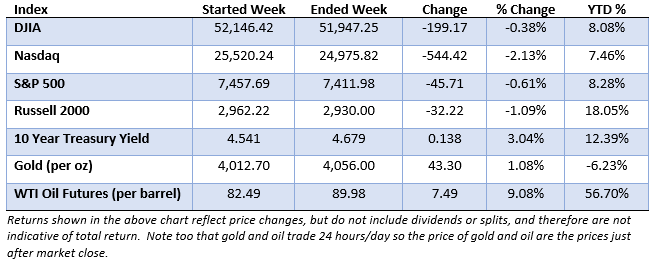
A sharp selloff in Alphabet and Tesla following their quarterly reports weighed heavily on technology stocks this week, as investors were reminded that even strong corporate results may not be enough to support today’s high stock prices. The Dow and Russell 2000 held up somewhat better than the Nasdaq, although all the major indexes were lower through Friday.
Treasury prices fell and yields climbed across nearly every maturity, with the 10-year yield reaching its highest level since early 2025. Last week’s softer consumer and producer price reports provided only temporary relief, as renewed tensions in the Middle East and a corresponding surge in oil prices quickly pushed inflation concerns back to the forefront.
Looking ahead, investors will turn their attention to next week’s Federal Reserve meeting, the first estimate of second-quarter economic growth, the latest inflation data, and another heavy round of corporate earnings. Together, these events may determine whether Mr. Market begins a broader reassessment of stock valuations and interest-rate expectations.
Market Performance
Market Commentary: The Bond Market Sends a Message
Something unusual is happening in the bond market. The yield on the 30-year Treasury has remained above 5% for its longest stretch since 2007 as investors have apparently become less willing to absorb an enormous supply of new bonds unless those bonds are accompanied by higher interest rates. At the same time, some of the country’s largest technology companies are issuing bonds to fund their ambitious artificial intelligence investments.
Inflation concerns are another part of the explanation. The surge in crude prices since the start of the month has stoked inflation concerns, as Iran-backed Houthi rebels in Yemen have begun attacking oil tankers in the Red Sea. That, in turn, has increased the odds that the Federal Reserve will raise interest rates, perhaps as soon as next week’s meeting.
Higher long-term interest rates have consequences well beyond the bond market. They increase mortgage rates, raise the federal government’s interest expense, and make it more costly for businesses to invest and expand. They also create additional competition for stocks, particularly when investors can earn approximately 5% from long-term Treasury bonds.
For years, the Federal Reserve could lower borrowing costs whenever the economy or financial markets needed support. The bond market is reminding us that while the Fed controls short-term interest rates, Mr. Market determines how much it costs to borrow for the long haul.
In Case You Missed It: Seeking Shelter
Despite a prolonged housing slump and mortgage rates driven higher by elevated bond yields, U.S. home prices climbed to another all-time high in June as a chronic shortage of homes for sale continues to prop up prices. The median sales price of previously occupied homes rose 1.8% year-over-year to a record $440,600, leaving many first-time buyers searching in vain for a place to call home.