
March 7, 2026 Market Update
Market Recap: Stocks Stumble
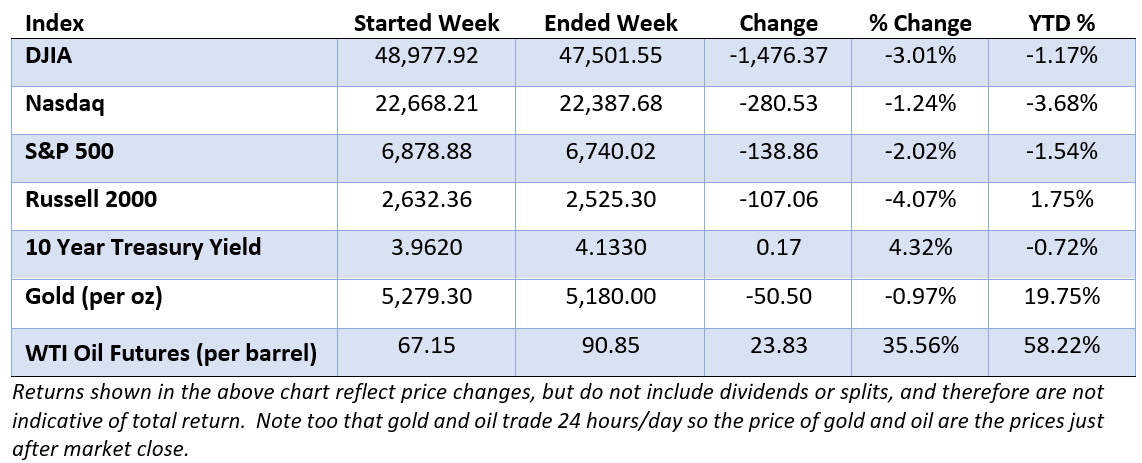
Geopolitical tensions and rising energy prices led to a volatile week on Wall Street. As the conflict in the Middle East intensified, investors grew increasingly concerned that higher oil prices could complicate the inflation outlook and potentially delay interest rate cuts from the Federal Reserve.
Stocks came under additional pressure on Friday following a weaker-than-expected jobs report, raising fresh questions about the strength of the labor market. While economic data overall continues to suggest the U.S. economy remains on relatively stable footing, the combination of rising energy costs and softening employment data left all four major market indexes finishing the week in the red.
In the bond market, Treasury yields moved higher, an unusual development during a period of geopolitical uncertainty. Normally, global instability leads investors to seek the relative safety of government bonds, pushing yields down. This time, however, inflation concerns appear to have prompted fixed-income investors to demand higher yields.
In the week ahead, investors will be watching closely to see whether the conflict in the Middle East shows signs of worsening. As discussed below, a sustained increase in energy prices could complicate the inflation outlook and become a key factor for markets.
Market Performance
Market Commentary: Energy Risk Reigns
Brent crude oil has risen roughly 50% this year and Brent crude recently traded above $92 per barrel, marking a new 52-week high. At the pump, average gasoline prices moved above $3.32 per gallon for the first time since November. Natural gas prices have risen sharply as well, largely because the conflict has disrupted liquefied natural gas (LNG) shipments from the Persian Gulf and forced several major facilities in Qatar to suspend production, tightening global supply.
In an effort to limit the economic fallout from higher oil prices, the Trump Administration has taken several steps aimed at keeping energy supplies flowing:
- President Trump has ordered the U.S. Navy to escort oil tankers through the Strait of Hormuz.
- A federal program has been directed to provide insurance coverage for maritime traffic moving through the channel.
- The administration has also signaled it may release crude oil from the Strategic Petroleum Reserve if energy prices continue to rise.
For now, Mr. Market will be keeping a close eye on energy prices. If the conflict is resolved quickly, prices could normalize in short order. But if the war spreads or escalates, supply disruptions could have lasting repercussions for inflation, interest rates, and the global economy.
For a more in-depth analysis of what the conflict in the Middle East could mean for the U.S. economy, see this post from TMC Research: Iran War Risk Still Low for the U.S. Economy — But the Safety Margin May Be Shrinking.
In Case You Missed It
The United States is now the largest oil producer in the world, pumping more crude than Saudi Arabia or Russia. That doesn’t mean higher oil prices won’t hurt consumers, but it does mean the U.S. economy is far less vulnerable to energy shocks than it was a generation ago.