
November 14, 2026 Market Update
Market Recap
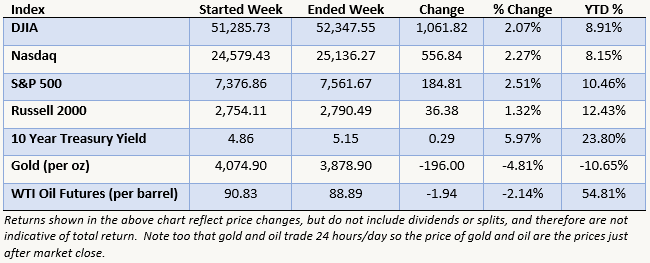
Despite heavy headline-driven volatility, U.S. stocks staged a strong recovery from last week’s post-midterm election selloff. All four major benchmarks posted strong gains for the week amid the political shakeup, surging bond yields, and the executive upheaval at Nvidia.
Bond yields climbed sharply after October's inflation report showed consumer prices rising faster than expected for the third consecutive month. Producer prices rose 6.5% over the past year, their fastest annual increase since November 2022. Together, the reports increase the likelihood that the Fed will raise rates at its December 8–9 meeting.
The market volatility in the last couple of weeks is a good reminder that it is nearly impossible to consistently know what the market is going to do week to week or month to month. These swings can take a toll on traders. Fortunately, long-term investors do not need to be able to predict market fluctuations. They just need the fortitude to stay the course.
Market Performance
Market Commentary: Work In Progress?
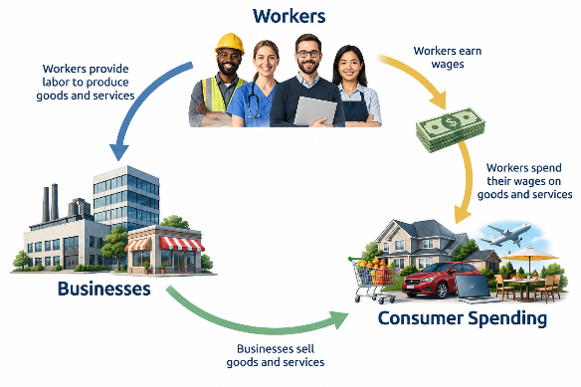
For centuries, workers have been an economic cornerstone. Employees provide goods and services, earn wages, and use those wages to purchase goods and services. Artificial intelligence threatens to disrupt this economic cycle.
Despite earlier assurances that AI would mainly help employees become more productive rather than replace them, evidence to the contrary is mounting.
- Microsoft offered voluntary buyouts to roughly 60,000 employees, more than a quarter of its workforce, as it sought to contain costs while investing heavily in AI.
- Amazon has eliminated approximately 30,000 corporate jobs in two rounds of layoffs, citing opportunities to improve efficiency through AI and other organizational changes.
- Other large technology companies have also reduced headcount while sharply increasing spending on artificial intelligence.
White-collar workers appear especially vulnerable because many tasks performed by programmers, analysts, administrators, and other professionals can increasingly be automated. Blue-collar workers may be safer for now, although advances in AI-powered robotics could eventually put many of those jobs at risk as well.
While AI is also creating new jobs and industries, just as earlier technologies did, there is no guarantee that new opportunities will appear quickly enough or in the right places to offset the jobs that disappear. If AI is to fulfill its promise without severely disrupting the economy, far more thought needs to be given to helping workers adapt to the changes it brings.
In Case You Missed It: Addition by Subtraction?
The World Economic Forum estimates that AI and information-processing technologies could create 11 million jobs worldwide by 2030 while displacing 9 million others. Even if that optimistic prediction proves true, there is no assurance that the workers who lose their jobs will have the skills needed to fill the newly created ones.