
November 7, 2026 Market Update
Market Recap: A Change In Heart.
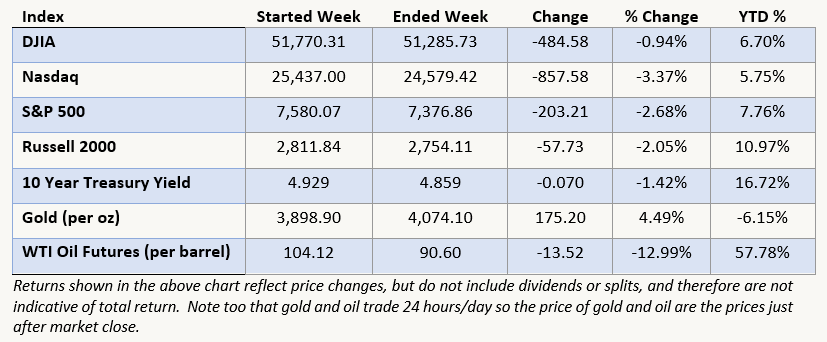
Mr. Market initially cheered Tuesday’s sweeping Democratic victory. The celebration proved short-lived. Two days after the election of a number of AI skeptics, the Nasdaq composite index lost an estimated $2.5 trillion in total market value on Thursday. Thursday’s selloff broadened to every sector of the S&P 500, with every one of the market’s major indexes finishing the week in the red.
The bond market fared considerably better as investors anticipated that a divided government will constrain future government spending and federal budget deficits. Falling oil prices eased inflation concerns and the stock-market selloff boosted investor sentiment and contributed to the rally. However, Friday’s strong jobs report strengthened the likelihood of another Fed rate hike in December, pushing bond yields modestly higher on Friday.
Sharp market swings like those seen this week are often the result of short-term positioning and market speculators being caught on the wrong side of a move, as opposed to a fundamental change in the long-term outlook for a market sector or the whole market. Investors, by comparison, should resist changing their investment approach simply because of a sudden spike in trader-driven volatility.
Market Performance
Market Commentary: Mr. Market Doesn’t Vote
Tuesday’s sweeping Democratic victory will shift control of both houses of Congress when the new Congress meets in January. President Trump will keep his veto power, and Democrats will lack the votes necessary to pass their agenda on their own.
Nevertheless, control of Congress gives Democrats considerably greater influence over federal spending, regulation and other policies that could affect financial markets well beyond the immediate post-election reaction.
For stocks, corporate earnings and economic growth will ultimately matter far more than which party controls Congress.
- Broader efforts to increase regulation of business can also be expected, especially due to the growing clout of the progressive left.
- Many key policies will continue to be shaped by the executive branch. President Trump’s authority over tariffs and foreign policy, along with his administration’s generally pro-business stance, could support corporate earnings and stock prices.
- Some sectors could benefit from the Democratic victory. Healthcare and consumer-oriented companies, for example, could benefit from an expansion of federal assistance programs.
For bonds, however, the election could have more long-term impact if it leads to still larger deficits and government borrowing.
- Democrats’ victory could add to already-large federal deficits if they use their newfound leverage to enact additional domestic spending.
- Larger deficits mean still more government borrowing. With the national debt already above $40 trillion, additional Treasury issuance could require higher yields to attract enough buyers, putting upward pressure on longer-term interest rates.
- Divided government could restrain new spending. Major fiscal legislation will require compromise between a Democratic Congress and a Republican president.
Election results inevitably generate short-term bets by traders about which investments will benefit and which will suffer, but history suggests investors should be wary of making long-term investment decisions based on politics alone. Mr. Market usually cares less about who won the election than how much their promises cost.
In Case You Missed It: The Ballot Box Bounce.
The S&P 500 has been higher six months after every midterm election since 1974, gaining an average of 12.4%, regardless of which party prevailed. It seems investors may be more encouraged that the election is over than concerned about who won.