
October 17, 2026, Market Update
Market Recap: Tech Troubles
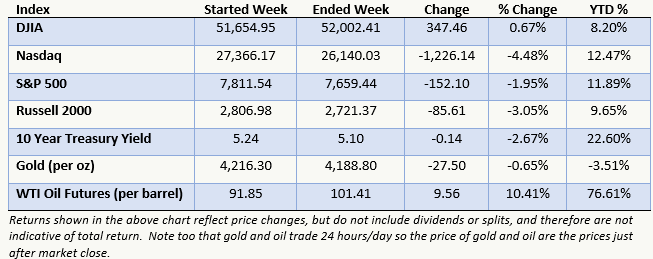
Mr. Market’s enthusiasm for artificial intelligence cooled this week as investors rotated out of semiconductor and other high-flying technology shares, despite strong quarterly earnings reports from industry leaders Taiwan Semiconductor and ASML. Concerns about elevated valuations, mounting debt associated with AI data-center construction, and higher borrowing costs weighed on technology shares. By Friday's close, the selling had spread to the broader market, with the Nasdaq and S&P 500 posting weekly losses while the Dow managed a modest gain.
Treasury yields fell sharply as investors sought refuge from the technology selloff and expectations of an immediate Fed rate hike moderated. The drop in yields came despite Wednesday’s Consumer Price Index (CPI) report, which indicated consumer prices rose by 3.7% year over year in September, and Thursday's Producer Price Index (PPI) report, showing prices rising 1.3% for the month and 6.3% year over year, the largest increases since 2022.
Doubts about massive AI-related spending are not necessarily bad news for long-term investors if they lead to a rotation into other market sectors less dependent on AI investment. On the other hand, if concerns about the technology sector deepen, the pullback could continue and potentially spread to the broader market.
Market Performance
Market Commentary: Figures Lie and Liars Figure
The Federal Reserve released its latest Survey of Consumer Finances last Friday. Published every three years, the report provides a detailed picture of Americans' financial well-being. Its findings offer reasons for both optimism and concern, depending on which numbers one chooses to emphasize.
On the positive side:
- Family Income Rises. Inflation-adjusted median family income has risen approximately 26% since 2013, reaching $82,200.
- Net Worth Grows. Median family net worth has climbed 91% since 2013, reaching $215,900, while average net worth now stands at $1.24 million.
- Stock Market Gains. Although stock market participation slipped from 58% to 56% between 2022 and 2025, the median value of stock holdings among invested families increased 36% to $77,400.
Not all the data in the report was reassuring, however.
- The Wealth Divide: The poorest 25% of families had a median net worth of just $1,700, down 56% since 2022. Median wealth for Black families also declined 25%.
- Mounting Debt Pressures: Between 2022 and 2025, the percentage of families devoting more than 40% of their income to debt payments rose from 6.5% to 8.6%.
- Younger Households Struggle: Over the same three-year period, families headed by someone under 35 saw their median net worth fall 23% to $33,000.
As is often the case with data-rich reports, there is something here to support almost every point of view. That said, two observations stand out to me. First, American families as a whole are considerably more prosperous than they were a dozen years ago, yet those at the bottom of the economic ladder still have relatively little wealth to show for it. Second, the contrasting findings are also a reminder of how easily numbers can be cherry-picked from reports like this to support whatever narrative one chooses.
In Case You Missed It: Top Heavy.
The 10 largest holdings in the S&P 500 now account for 39.5% of the index, according to market strategist Charlie Bilello. With so much of the index concentrated in a handful of technology-related companies, a downturn in just a few stocks could have a major impact on the broader market.