September 26, 2026 Market Update
Market Recap: Tug Of War
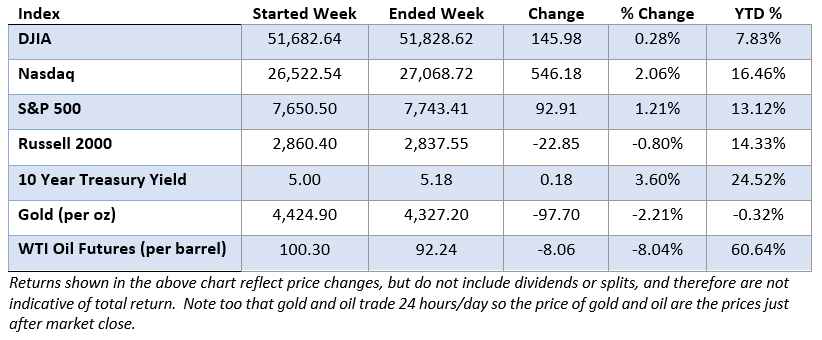
U.S. stocks started the week on a strong note on falling oil prices and optimism about AI’s potential to boost company earnings, with technology shares once again leading the rally. Those gains faded as the week progressed as oil prices rebounded and rising interest rates again weighed on investor sentiment. By Friday’s close, the major indexes finished the week modestly higher, capping a week of back-and-forth sentiment driven by mixed economic data and inflation concerns.
The bond market experienced even greater volatility. After falling below 5% early in the week, the 10-year Treasury yield climbed above 5.1%, reaching its highest level since 2007, while the 30-year yield hit its highest level since 2004. Wednesday’s S&P Global Composite PMI was its strongest reading in more than five years, adding to concerns that a resilient economy and persistent inflation could require additional Federal Reserve rate increases.
Meanwhile, President Trump’s meeting with Chinese President Xi Jinping on Thursday serves as another uncertainty for investors to wrestle with. On the one hand, an extension of the trade truce should limit near-term tariff volatility and provide more time for negotiations. On the other, the intense competition over AI dominance, regional security, and global economic influence is not likely to moderate any time soon. For retail investors, these developments reinforce the benefits of diversification and heighten the risks of trying to pick who the winners and losers will be.
Market Performance
Market Commentary: May The Force Be With You.
The U.S. economy continues to show surprising strength.
- The S&P Global Composite PMI, a leading measure of business activity, rose to 58.4 in September, its highest level in more than five years.
- Retail sales have jumped 1.2% in August.
- Employers added 162,000 jobs last month and the unemployment rate remained at 4.1%.
Ordinarily, that would be welcome news. But these are not ordinary times.
With inflation still running above the Federal Reserve’s 2% target, a stronger economy may also increase the likelihood that interest rates will have to rise further and remain there longer. Consumer prices rose 3.4% over the past year and have been above the Fed’s 2% target for 66 months.
The central bank has begun fighting back. It raised interest rates another quarter point last week and its latest projections suggest another rate increase may be necessary before year-end if inflation stays stubborn and economic activity stays hot.
That leaves Mr. Market caught between two competing forces. Economic strength supports consumer spending and corporate profits, while rising interest rates increase borrowing costs and put downward pressure on economic activity and asset prices. Which force ultimately prevails may go a long way toward determining the direction of both stocks and bonds in the months ahead.
In Case You Missed It: Surging Mortgage Rates
Mortgage rates have surged above 7%, with the average 30-year fixed rate reaching 7.03%, its highest level since May 2024. On a $500,000 mortgage, that means a monthly principal-and-interest payment of about $3,337, compared with roughly $2,168 when rates were 3.22% at the start of 2022—an increase of nearly $1,170 a month, or more than $421,000 over the life of the loan.