
September 5, 2026 Market Update
Market Recap: Searching For Direction
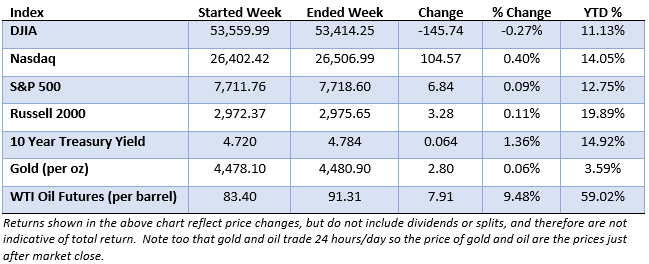
U.S. stocks stumbled out of the gate this week as escalating tensions with Iran sent oil prices higher and renewed concerns over inflation. Technology shares led the market lower early in the week before staging a late-week rebound as energy prices stabilized and investor sentiment recovered.
Bond market volatility continued, with yields moving higher Friday morning following the stronger-than-expected August employment report, which showed employers adding 162,000 jobs while the unemployment rate held steady at 4.1%, signaling continued labor market resilience despite elevated borrowing costs.
Looking ahead to next week, investor attention will center on key inflation data. Producer prices arrive Thursday, followed by the Consumer Price Index on Friday. Coming just days before the Federal Reserve’s policy meeting, these reports will likely help determine whether central bankers keep interest rates on hold or consider further tightening.
Market Performance
Market Commentary: Fiscal Shenanigans
Bond investors around the world are getting nervous. Government bond yields in the United States, Japan, Germany, and the United Kingdom all surged higher this week, continuing a global selloff that has been building for months.
The reasons vary from country to country, but they share a common thread: governments are borrowing enormous amounts of money and politicians are showing little appetite for the spending cuts or tax increases needed to bring their budgets into balance.
Instead, some politicians are proposing financial gimmicks to sidestep fiscal constraints. In France, presidential candidate Jean-Luc Mélenchon has proposed effectively eliminating a portion of the country's debt held by its central bank. Americans may remember similar discussions during past debt-ceiling battles, when some suggested that the Treasury mint a trillion-dollar coin and deposit it at the Federal Reserve to keep paying bills without issuing additional debt.
Such accounting tricks may make government finances look better on paper, but they do not eliminate the underlying problem when a country continues spending more than it collects. For decades, governments could borrow massive sums at historically low interest rates. Mr. Market seems to be warning them that those days are coming to an end.
In Case You Missed It
The Organization for Economic Cooperation and Development (OECD) estimates its 38 member countries will borrow roughly $18 trillion this year, with nearly 80% going simply to refinance existing debt. Today's higher interest rates are making yesterday's borrowing increasingly costly.